

First things first, let’s get familiar with salary benchmarking…
With a wealth of free information at their fingertips, employees are more informed than ever about market rates of pay for their roles.
Having market intelligence, as well as a good understanding of where your organisation sits in relation to the market, is essential to setting an effective reward strategy.
To compete for talent and retain key people, your organisation must not only develop fair and market-competitive salary ranges, but review them on a regular basis. This guide delves into the concept, importance, implementation, and best practices of salary benchmarking.
What Are Your Pay Objectives?
Does your organisation have a reward strategy? If it does, is it linked to your business objectives?
If so, you are likely to have a clear idea of what you are looking to get out of benchmarking salaries in your organisation. Your reward strategy should answer key questions such as:
- Who are your key competitors?
- Do you want to be a market median payer or lead the market?
- How does base salary fit into your overall reward strategy?
- Are you looking to drive high performance or is retention your top priority?
The Importance of Salary Benchmarking
Attracting Top Talent
Benchmarking serves as a valuable tool in enabling you to offer competitive pay. Salaries that fall below the market rates can result in difficulty attracting and retaining skilled professionals.
Determining competitive levels of pay means you can position yourself as an attractive employer. Including pay ranges and benefits in job descriptions also increases transparency and helps candidates make informed decisions about their career choices.
Ensuring Fairness and Transparency
To comply with the Equality Act 2010, people doing ‘like work’ should be compensated equally.
Salary benchmarking helps compare your pay and benefits structures with industry ranges. As a result, you can ensure that your employees are being paid fairly for their roles, experience levels, and contributions.
This, in turn, contributes to creating a positive work environment and fostering trust and engagement among the workforce.
Managing Company Costs and Budget
Moreover, salary benchmarking aids in effectively budgeting for and managing your company’s pay strategy. By understanding the market rate for a specific role, you can make more informed decisions about pay ranges, thereby attracting the needed talent without overspending.
Non-Discriminatory Decisions
By researching salary data and comparing internal job descriptions with those of other companies, you can make impartial, data-led decisions. This approach eliminates bias and promotes diversity and inclusion within your organisation.
The Planning Stage
Designing a Comprehensive Plan
The first step in implementing a successful process is to design a thorough plan that serves as a roadmap. This should include long and short-term pay goals, timelines, budgets, necessary resources, and the purpose.
Job Descriptions
Job descriptions are essential for salary benchmarking. They allow for the identification of similar positions in different organisations, even when the job titles may vary.
When it comes to job matching, this process must be carried out by evaluating the roles and understanding the content as well as the required skills and competencies. If your descriptions are out of date or your business has gone through significant change, then you may need to start by reviewing and updating these first.
Quality Data Collection
The quality of data collected will determine the accuracy of your benchmarking. Building credibility can be a challenge, so it is important that you understand how market surveys work. You should be able to clearly articulate:
- How the data is collected
- Whether it is aged
- Geographical coverage
- How the final output is calculated
This data will ultimately impact managers’ pay decisions. If they don’t trust the data, it is unlikely that you will be able to coach and influence them, rendering the whole process a wasted effort.
Defining Your Pay Philosophy
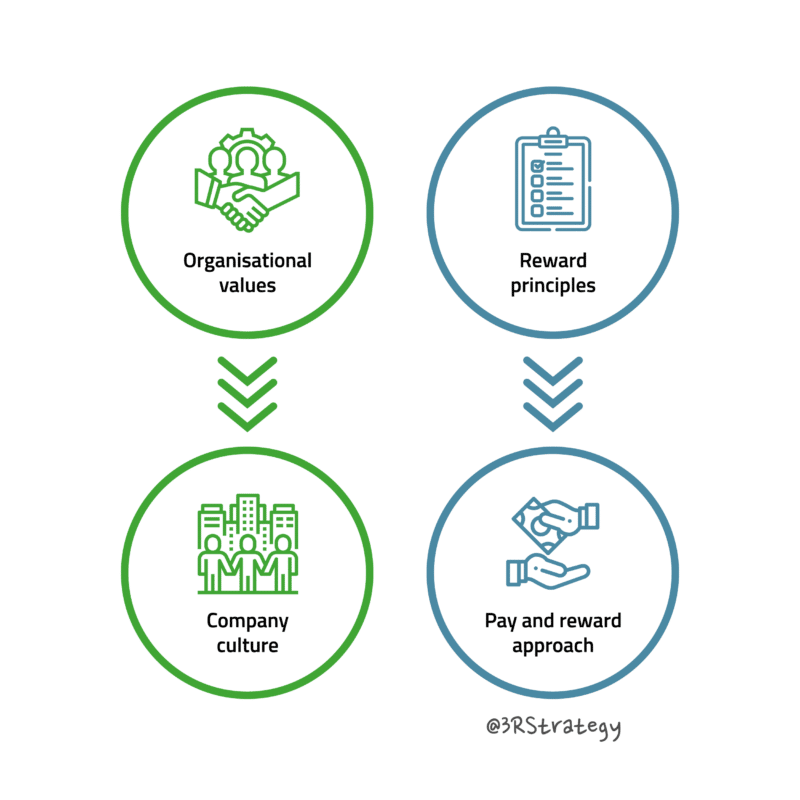
Your pay philosophy should guide the benchmarking process. Aligning external salary benchmarks with your principles allows for the creation of competitive, fair salaries that align with your budget and reflect your approach to pay.
The Steps To Salary Benchmarking
1. Gathering Data
Applicable to both current employees and new hires, salary surveys provide the basis of internal pay frameworks and budgeting of future salaries. You can choose between traditional and crowdsourced surveys but should be aware of the pros and cons of each.
2. Assessing The Numbers
HR professionals are used to being inundated with salary surveys and job ads. When looking at this information, it’s important to keep in mind that:
- Employees will inevitably present examples with the highest paid salaries.
- Job ads and recruitment data tend to show what companies are willing to pay, rather than what they are actually paying.
- Recruitment data is not robust and is often based on job titles rather than what the roles actually entails.
Getting salaries right is critical to attracting and retaining key people in your organisation, which is why it pays to invest in a good primary data source.
3. Job Levelling
Most salary surveys have a job levelling structure that presents a series of progressively senior roles distinguished by knowledge, skills and competencies.
If your organisation already has a job levelling framework, the next step is to establish a link between your organisational levels and the levels in the survey data you have chosen.
If you don’t, then the process becomes a bit more complex. To begin, you will need profiles and organisation charts for all the roles you are looking to benchmark, as we mentioned earlier.
4. Matching Job Categories
Once we’ve looked at the levels, step two is matching each role to the function, or job category. This is where you need to understand the broader skills or business area for the role so that you can find a similar match in the survey.
For example, the closest match to a project management role would probably be a project management function in a survey. But it might not be this straightforward.
A social media management role, for example, would probably fit into the marketing function of the survey. In these cases, it is down to you to decide on the best fit according to the broader skills and requirements of each role.
5. Salary Benchmarking Report
Perhaps the simplest and most effective way to present your pay benchmark data is by showing the compa-ratio for each employee. Compa-ratio is the employee’s current salary divided by the current market rate for that role – as defined by the surveys you are using. Presenting reports in this way gives managers just the right amount of detail and helps them to make more informed pay decisions.

Best Practices for Effective Salary Benchmarking
Whether you present your data using compa-ratios or in any other way, it is crucial that you run training sessions with your managers to give them an understanding of the data, as well as the job evaluation process.
Simply sending a pay report to managers without prior training can have an adverse effect; they can only make informed decisions if they have a good understanding of the data and confidence in the process